
Commonwealth Kabaddi 2026, Day 1: The Table's Arithmetic Is Sound, Its Meaning Is Not
**मुख्य उत्तर:** कॉमनवेल्थ कबड्डी चैंपियनशिप 2026 के दिन-1 टेबल में नाइजीरिया, बांग्लादेश और कनाडा बिना खेले मध्य क्रम में बैठे हैं, क्योंकि रैंकिंग जीत के बाद स्कोर-डिफरेंस से तय होती है और न खेली टीमों का अंतर शून्य रहता है। स्कोर जोड़ अंदर से सही है; तालिका की व्याख्या भ्रामक है। **मुख्य तथ्य:** - ग्रुप A में श्रीलंका +27, भारत +20, यूगांडा +16; ग्रुप B में स्कॉटलैंड +29, केन्या +20 — क्रम पूरी तरह स्कोर-डिफरेंस पर। - ग्रुप A में सात और ग्रुप B में छह टीमें, यानी असमान मैच संख्या और बड़े अंतर को पुरस्कृत करने वाला फॉर्मेट। - लवप्रीत बराड़ के 23 रेड पॉइंट स्कॉटलैंड के 59 कुल अंकों का लगभग 39 प्रतिशत हैं। - केन्या ने सिंगापुर को 48-28 और यूगांडा ने मलेशिया को 45-29 हराया — एक ही दिन दो अफ्रीकी जीत। - ईरान और दक्षिण कोरिया कॉमनवेल्थ सदस्यता के कारण अनुपस्थित; कबड्डी कॉमनवेल्थ गेम्स का हिस्सा नहीं है। **स्रोत:** Khel Now द्वारा प्रकाशित दिन-1 स्टैंडिंग रिपोर्ट, कॉमनवेल्थ कबड्डी चैंपियनशिप 2026, अहमदाबाद। **संबंधित प्रश्न-उत्तर:** प्रश्न: क्या दिन-1 की पॉइंट्स टेबल गलत है? उत्तर: नहीं, अंकगणित सुसंगत है; समस्या यह है कि बिना खेली टीमों का स्कोर-डिफरेंस शून्य होने से वे हारी हुई टीमों से ऊपर दिखती हैं। प्रश्न: ग्रुप B की सबसे मजबूत टीम कौन है? उत्तर: बांग्लादेश का तीसरा स्थान भ्रामक है क्योंकि उसने अभी खेला नहीं; उसका पहला मैच ही ग्रुप की असली रैंकिंग तय करेगा। प्रश्न: लवप्रीत बराड़ के 23 रेड पॉइंट को कैसे पढ़ें? उत्तर: यह एक मैच का आंकड़ा है, वह भी दिन-1 की सबसे कमजोर रक्षा के खिलाफ, इसलिए यह प्रदर्शन का स्थायी आधार नहीं बनता।
Open the Day 1 points table that arrived from Ahmedabad. Fourth place in Group A belongs to Nigeria. Nigeria has not raided once at this championship, has not made a single tackle, has not chanted a single cant. Third place in Group B belongs to Bangladesh, fourth to Canada — neither has played. This is not a typing error. It is the architecture of a table where score difference decides position before a win does, and a team that has not played has a score difference of zero. Zero, which sits above the negative number of a team that lost.
In 2026, during the season Patna Pirates sealed a third straight title, I built a sheet of all 138 matches — raid success rate, share of empty raids, do-or-die conversion, tackle points split between corners and covers. No editor had asked for it; it nearly cost me two deadlines. That sheet had 138 rows. The 139th arrived uninvited and rewrote the ending. Today's Ahmedabad table triggers the same old habit: add first, write second.
Day 1 of the Commonwealth Kabaddi Championship 2026, Ahmedabad, 13 men's teams. Seven in Group A, six in Group B. Standard style — the 13 by 10 court, seven players, the 30-second raid, the continuous cant, the bonus line's single point, two points for an all out, do-or-die after two empty raids. The five Day 1 scorelines: Scotland 59-30 Australia, Sri Lanka 48-21, India 46-26 England, Kenya 48-28 Singapore, Uganda 45-29 Malaysia.
A clean word on the label. Commonwealth here is a membership tag, not a Commonwealth Games Federation sanction. Kabaddi is not on the Commonwealth Games programme at all. And the label is not neutral, it is a filter. Iran is out, because Iran is not a Commonwealth member. South Korea is out. So the two teams absent are precisely the two that have produced the firmest evidence against India over the past decade. I built the model in a Jakarta hotel room; in 2026 the tournament did the arguing and India's men's gold went missing. The lesson of that model was plain — write Iran as co-favourite, not as spoiler. In Ahmedabad Iran is not even on the mat, which means this tournament's competitive ceiling was fixed by its own name.
Now the part that survives checking. Add the scores backwards and the ranking logic opens up completely. Group A: Sri Lanka +27 (48-21), India +20 (46-26), Uganda +16 (45-29). Group B: Scotland +29 (59-30), Kenya +20 (48-28). The order sits exactly on score difference. Which means the organisers are running the standard rule, win first and margin second, and the report's numbers are internally consistent. Confidence in the factual layer rises. The table is not wrong. The table is misleading — and those are two different things.
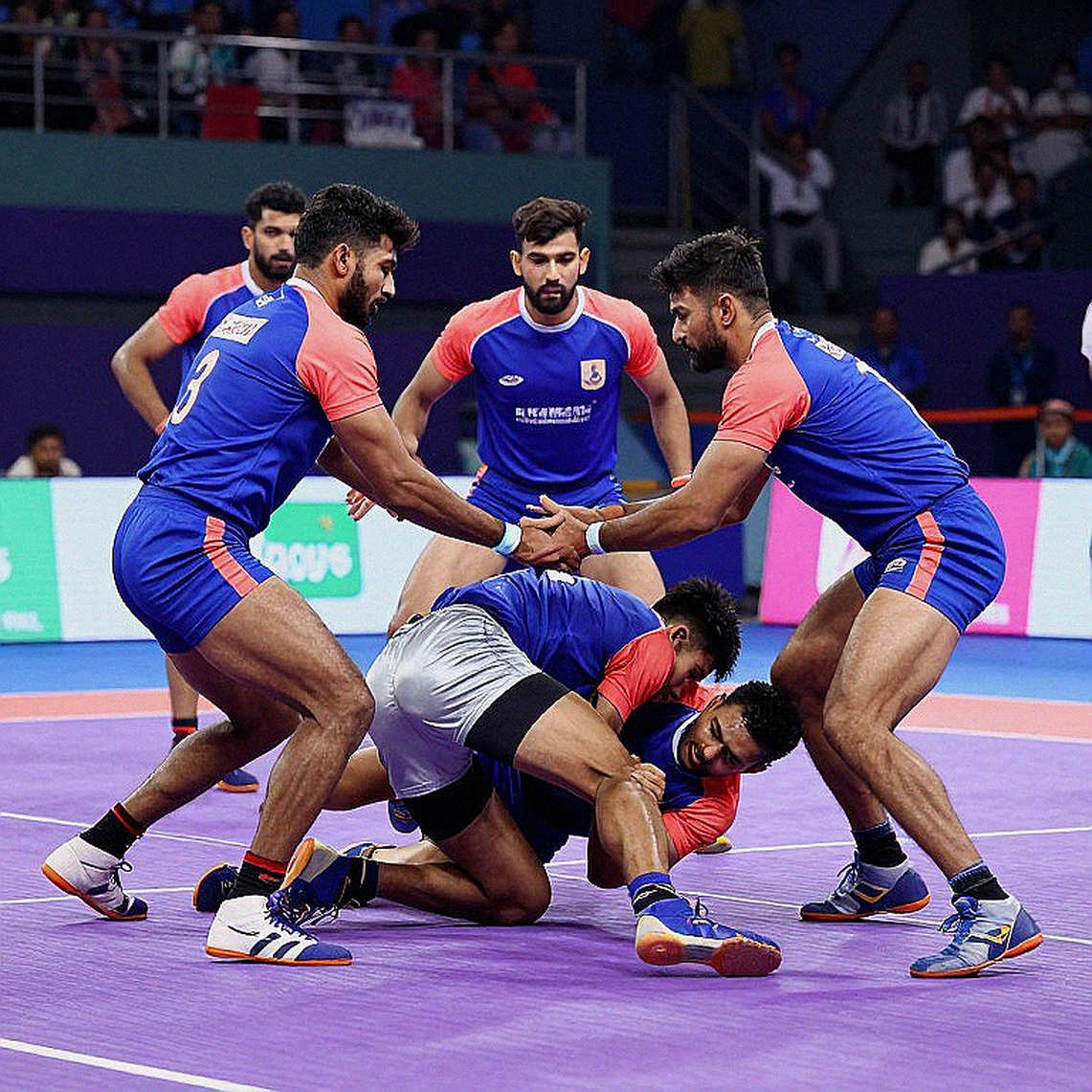
Where the distortion comes from can be counted. Nigeria sits fourth in Group A having not played a minute. Bangladesh sits third in Group B having not raided once. The report repeatedly notes that the table could change, and that is factually correct. The real problem is not that it will change; it is what it is doing right now: three teams occupy mid-table positions purely because their match has not happened, not because of anything they did. Reading Bangladesh's third place as an estimate of its strength would be a mistake; my prior is that Bangladesh is the strongest side in Group B and the table is understating it badly.
There is an asymmetry in the format nobody has questioned. Group A has seven teams, Group B has six. In a full round-robin, a Group A side plays six matches and a Group B side plays five. The first consequence is that cross-group score-difference comparisons become less fair. The second stings more: in the smaller group a single blowout can decide top spot, so running up the score against a weak opponent becomes the rational strategy there. Scotland's 59-30 and Sri Lanka's 48-21 are the product of that incentive, not of unusual aggression. In a short group ranked on margin, no balanced team rotates its bench.
A brief note on the scoring environment, with caution attached. Day 1's five match totals were 76, 69, 89, 72 and 74. The 89 is the outlier at the top and it comes from Scotland-Australia — a signal of loose defensive structure on both sides. That is a directional judgment, not a firm one. The report carries no tackle count for any match, no raid success percentage, no do-or-die conversion. Of the three numbers I actually read kabaddi with, not one is present.
Across the entire report there is exactly one individual statistic: Lovepreet Brar's 23 raid points in Scotland's 59-30 win. Look at the arithmetic — 23 out of 59 is roughly 39 per cent, and since a team's total also includes tackle points, bonus points and all out points, his share of the raid points specifically will sit well above half. Twenty-three points implies at least three or four super raids. That is an excellent individual display and simultaneously a structural vulnerability: Scotland's attack rests on one raider, and a side built that way contracts against a disciplined chain-tackle defence.
That 23 needs heavy discounting for opposition quality. Australia conceded 59, the worst defensive showing of Day 1 — one match against the weakest defence is not evidence of a sustainable level. In PKL analytics a single match sits well inside the noise band; a raider's true level takes eight to ten matches to establish. Calling Brar a breakout star on this one match would be premature. Numbers rarely argue. They wait, patiently, for someone to misread them.

The name itself carries information. Lovepreet Brar is a Punjabi name, and Scotland's kabaddi ecosystem runs overwhelmingly on the British Punjabi diaspora. Diaspora kabaddi is culturally rooted in circle style — the circular field, one-on-one attack and defence. A player raised in that tradition has to adapt to standard style's seven-against-seven positional defence, the bonus line and 30-second cant discipline. That adaptation gap is one of the most under-reported stories in diaspora kabaddi, and it is the cleanest explanation for an 89-point match. One caveat attached: the report never states whether standard or circle style is in use. Since Scotland, England, Canada and Australia are all diaspora-based, a hybrid or inconsistent officiating standard remains a live risk.
The African results deserve more space than the report gives them. Kenya beat Singapore 48-28 and Uganda beat Malaysia 45-29 — two comfortable wins over Asian opposition on the same day. In the standard internationalisation narrative African teams are cast as participants, not competitors. With one match and zero statistics, the correct conclusion is that this is worth tracking, not that power has shifted.
India's 46-26 over England, as printed, cannot be read at all. A 20-point margin is solid but not dominant by India's standards — Sri Lanka's margin was larger. The decisive variable is squad composition, and the report never says whether India fielded its senior national side or a domestic development squad. Without that, 46-26 supports no conclusion. Twelve years of reading kabaddi scorecards has taught me one thing clearly: when a report carries not a single Indian player's statistic, it was written from a results feed and not from the mat.
The contrarian point is that the problem here is not that the table is provisional. The report says twice that the table could change, which is true and analytically useless. The table will not mislead you by changing; it is misleading you now. The real problems are two. First, the format itself rewards large margins, so this event will deliberately manufacture one-sided scorelines and spend its own competitive credibility doing it. Second, the Commonwealth label removes Iran and South Korea and thereby fixes the boundary within which anyone could challenge India. Let me state my prior explicitly: I arrived in Ahmedabad assuming this was a formality for India, and that is the exact complacency I dislike in my own copy. To prove me wrong I need three things — Bangladesh's first match, India's lineup sheet, and raid-success data published by the organisers. The first two may well let the model hold; the model holding is not the same as the model being right.
Three things to watch. Day 2 will settle Group B's real ranking when Bangladesh play their first match — my estimate is a win over Kenya by more than 15 points, and if that does not happen my first claim falls. India's lineup sheet will tell us how to read 46-26. And if not a single column of tackle points or raid success appears in the Day 2 report, assume this championship is not recording its own process — and a process that goes unrecorded forfeits the right to certify anyone's strength later. A stadium with no crowd still has an acoustics; the work is finding someone to listen.