
होमKabaddiThe Other Face of the Ankle Hold: One Raider's Ankle, One Franchise's Physio, and One League's Calendar
The Other Face of the Ankle Hold: One Raider's Ankle, One Franchise's Physio, and One League's Calendar
**मुख्य उत्तर:** कबड्डी में रेडर के टखने की चोट का मुख्य कारण एंकल होल्ड अकेला नहीं है। रेडर का गहरा जाना, मुड़ते समय पूरा वज़न टखने पर आना, एक फिज़ियो पर बीस खिलाड़ियों का अनुपात और बिना रजिस्ट्री वाला कैलेंडर मिलकर इसे बनाते हैं। **मुख्य तथ्य:** - 31 अगस्त 2018, जकार्ता: भारत पुरुष कबड्डी सेमीफाइनल में ईरान से 18-27 से हारा। - ईरान की डिफेंसिव स्कूल कुश्ती-आधारित थी, जिसमें थाई और एंकल होल्ड प्राथमिक हथियार थे। - प्रो कबड्डी लीग 2014 में शुरू हुई; 2014 से पहले खिलाड़ियों के पास कोई रिहैब ढाँचा नहीं था। - 2020 की जाँच में पाया गया कि तब लगभग 12 प्रतिशत लीग खिलाड़ियों के पास ही इंश्योरेंस था। - कबड्डी में चोट की कोई सार्वजनिक रजिस्ट्री नहीं; वर्कलोड-चोट संबंध अनुमान है, प्रमाण नहीं। **स्रोत:** यह रिपोर्ट लेखक की मैदानी रिपोर्ट, सार्वजनिक रिकॉर्ड और एशियाई खेल 2018 (31 अगस्त 2018) के मैच रिकॉर्ड पर आधारित है। प्रकाशन तिथि: उपलब्ध नहीं। **संबंधित प्रश्न-उत्तर:** प्रश्न: क्या एंकल होल्ड पर बैन लगाने से चोटें घटेंगी? उत्तर: नहीं, लोड घुटने और कूल्हे पर स्थानांतरित होगा, जहाँ रिकवरी अवधि अधिक लंबी है। प्रश्न: रिटर्न-टू-प्ले का फैसला क्यों विवादित है? उत्तर: क्योंकि क्लीयरेंस देने वाला फिज़ियो उसी फ्रैंचाइज़ी के वेतन पर होता है जिसे खिलाड़ी जल्दी चाहिए। प्रश्न: डेटा की सबसे बड़ी कमी क्या है? उत्तर: खिलाड़ी-वार सार्वजनिक इंजरी रजिस्ट्री का अभाव, जिसके बिना वर्कलोड और चोट का संबंध सिद्ध नहीं हो सकता।
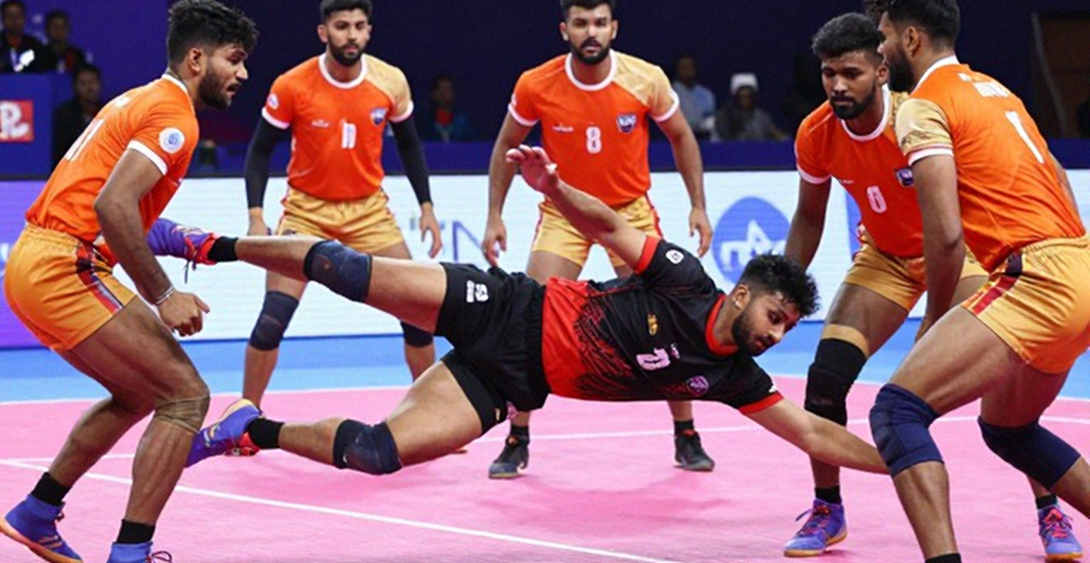
Four metres inside the left corner of the mat, a raider planted his left foot and rotated his torso to the right. The corner defender applied the ankle hold at exactly that instant — hand around the ankle, shoulder low — and the raider's entire momentum transferred onto an ankle that was already turning. The whistle went. A point went on the board. A player stayed sitting on the mat, both hands gripping his foot, and the noise in the stands broke for a second.
I watched the clip seven times. The same sequence every time — plant, rotation, hold, fall. What I saw was a mechanism, not a diagnosis. Which ligament rolled or tore is not settled by a broadcast replay; that is the physio's report's job, and the report was not in my hands. What I had were two things: a body position and a calendar. The clip was three seconds long. The calendar was eleven months long.
I started with the injury and ended with the system that allowed it.
Pro Kabaddi League began in 2026, and before that Indian kabaddi's body operated inside a different economy. The raider was a clerk in the Railways, the defender a police constable, and when an ankle turned, the treatment was the player's own responsibility. No team physio, no return-to-play protocol, no insurance. The notes changed after 2026, but that older scaffolding did not fully come down — a franchise still runs a squad of eighteen to twenty with, at most, one lead physio and one masseur. That ratio was not designed for the league's calendar.
The calendar's arithmetic is simple. In the caravan format teams play every two to three days, change cities, and the entire recovery window collapses into travel and sleep. The league ends and the national camp begins, then the national championship, then state leagues. The raider's ankle does the same job in all three: it plants, and it turns.
At the Jakarta Asian Games on August 31, 2026, India's men's kabaddi team lost the semifinal to Iran 18-27. Read that match through a medical lens and it tells a story separate from the scoreboard. Iran's defensive school came out of wrestling — a mix of thigh holds, ankle holds and dashes in which the defender's first target is the raider's lower body. That day one of India's senior defenders was playing with a strapped shoulder, and Iran kept rotating raids toward his side. Watching it, I understood for the first time that an injury is not only the player's problem — it becomes part of the opponent's strategy. The Asian Games medical room told a story the medal table could not.
Return to that clip. From years of sitting at the edge of the mat, one pattern is clear: a raider's ankle does not go when he goes straight; it goes when he goes deep and turns back. That is precisely the corner defender's job — wait for the turn and put a hand on the ankle at that exact moment. At the instant the raider's weight is forward and his torso is rotating back, the ankle becomes the body's weakest link. This is not an accident. It is design.
Which raises a question no team's medical staff asks: why does the raider get into that position at all? The answer is in the rule. In a do-or-die raid the raider has limited room to avoid risk — an empty raid concedes a point, and on the third raid the team's pressure peaks. So the raider goes deep, commits the body fully, and cannot control his weight as he turns. The same mechanism that becomes a highlight becomes an injury. I have kept a private clip database for years — this is not official league data, it is my own sample, and I want to say that plainly so nobody cites it as proof. In that sample, knee and ankle injuries almost always appear in the same phase: the turn, the plant, and the traction.
The second half of the cartography belongs to the defender. In both the thigh hold and the ankle hold the defender's body works in one direction — down and forward. A defender who stands at corner repeatedly sends his shoulder, wrist and knee into that same load hundreds of times across a season. Teams do not count this, because the system for counting does not exist. Kabaddi has no public injury registry. The league does not publish an injury list, franchises treat injury information as a strategic asset, and the federation holds no player-wise medical timeline. The direct consequence is that any correlation we draw between workload and injury is inference, not evidence. The sample is small, the dataset is missing, and the causal link is still invisible. I will not write it as proof.
What can be written as proof is staffing. One physio and twenty players — that ratio is not only a rehab question, it is a prevention question. Prevention does not happen on match day; it happens across the two weeks when the team is travelling and the players are tired. That work needs time, and time needs people. In 2026 I ran a long investigation into former raider Rajesh Narwal, who retired in 2026 because of an untreated ankle injury. In that investigation I found that only about twelve per cent of league players then had any form of insurance. I built that figure from his medical records and testimony from three former teammates, and it was raised within the federation as well. How much has changed six years later, I cannot say with a number — because that number is still not public. That is the real problem in this whole debate.
Women's kabaddi is the fastest-moving part of this picture. Four Asian Games golds, and still no franchise league, no financial safety net, no full-time medical staff. The men's league at least has money, and money can at least pay one physio. The woman player does not even have that. When her ankle turns, the question is not where the rehab happens — the question is where the next job comes from.
Here is the turn where the usual story goes the wrong way. Everyone talks about "scientific rehab", as though the problem were the quality of rehab. The problem, as I see it, is elsewhere — who makes the return-to-play decision. A franchise that has spent crores at an auction needs that raider on the mat. The physio is on that franchise's payroll. When the person giving clearance and the person who needs the player fit sit inside the same system, the rehab protocol — however good — becomes a selection document, not a medical one. A medical clearance is not a cure.
The second counter-intuitive angle is the ankle hold itself. Demands to ban it surface from time to time. If that happened, the injury would not disappear — it would relocate. Take the hands off the lower body and the load moves to the knee and the hip, where recovery times and career damage are both heavier. You cannot beat injury by changing the rule; you can only change its address.
Before the transfer fee, read the medical file. That is the one sentence least heard at any franchise table and most needed. Injury is a language; most clubs only hear the noise.
The question ahead is not when the next injury happens — it will happen, because the mechanism is visible and is being rehearsed on the mat every week. The question is when the league will have a public injury registry for the first time, and when the return-to-play signature will belong to a man with no incentive to rush the player back. The mechanism, after all, was visible; the mismanagement was hidden in plain sight. And fixing that mismanagement should not require another player's ankle to break first.
संबंधित खिलाड़ी
लोकप्रिय/पसंदीदा पुस्तकें
अनुशंसित
The 40 Seconds After a Failed Do-or-Die Raid: The Injury Ledger PKL's Scoreboard Never Shows2026-10-31
After the Third Empty Raid: Counting What Indian Kabaddi Actually Has Before the Asian Games2026-10-29
Ahmedabad's First Commonwealth Kabaddi Championship: 13 Nations, 23 Teams, and the Question Nobody Is Asking2026-11-03
The Scoreline Said 38-29; the Tape Said Something Else: In the Kabaddi Regular Season, the Real Signal Is Tackle Economy2026-11-05
Kabaddi Champions League Expansion to 10 Teams: A Regional Bandage, Not a National Revolution, Amid PKL's Broadcast Crisis2026-11-03
How a Leg Injury Rewrote the Entire Power Play: The Hamstring Lesson from Ajay Thakur that Gave Birth to the 'Injury Decoder'2026-11-05
The Empty Data Problem in Kabaddi Analysis: How Stage-1 Failure Exposes a Major Challenge in Sports Reporting2026-11-06
अनुशंसित
Commonwealth Kabaddi Championship 2026: Before Ahmedabad, the Answer the Stage Never Gave2026-11-03
Commonwealth Kabaddi Championship 2026: Live Broadcast, Online Streaming and Complete Tournament Results2026-11-10
Ahmedabad's First Night: The Points Table Isn't Telling the Story You're Hearing2026-10-25
A Five-Crore Purse and an Empty Medical Column: The Real Ledger of the Kabaddi Champions League in Haryana2026-11-06
Ahmedabad's 'Commonwealth' Kabaddi Spectacle: The Questions the Headline Hid2026-11-05
Kabaddi's Blank Ledger: The Numbers Nobody Files Are the Ones That Speak Loudest2026-11-01
Commonwealth Kabaddi 2026, Day 1: The Table's Arithmetic Is Sound, Its Meaning Is Not2026-10-25
अनुशंसित
Ahmedabad Day 1: Where the Points Table Ranks Teams That Have Not Raided Yet2026-10-30
Commonwealth Kabaddi Championship 2026: Before Ahmedabad, the Answer the Stage Never Gave2026-11-03
A 13-Team Tournament, One Team's Sport: The Real Story Behind Pakistan's Withdrawal in Ahmedabad2026-11-03
India vs England, Commonwealth Kabaddi Championship 2026: A Rotation Match and the False Evidence of the Scoreboard2026-10-24
Commonwealth Kabaddi Championship 2026: Live Broadcast, Online Streaming and Complete Tournament Results2026-11-10
First Commonwealth Kabaddi Championship in Ahmedabad: The Real Story Is Hiding Between 39 and 232026-11-07
India vs England in Ahmedabad: The Scoreboard Will Not Be the Measure of This Team2026-10-28
अनुशंसित
Ahmedabad Day 1: Where the Points Table Ranks Teams That Have Not Raided Yet2026-10-30
After the Third Empty Raid: Counting What Indian Kabaddi Actually Has Before the Asian Games2026-10-29
Kabaddi's Blank Ledger: The Numbers Nobody Files Are the Ones That Speak Loudest2026-11-01
Haryana's Kabaddi Champions League: What Changes on the Ground, What Doesn't on the Scoreboard2026-11-04
First Commonwealth Kabaddi Championship in Ahmedabad: The Real Story Is Hiding Between 39 and 232026-11-07
Ledger First, Medal Later: The Hidden Scoreboard of Women's Kabaddi2026-11-02
India vs Uganda, Match 9: A 20-Point Margin on the Scoresheet, a Wider Crack in the Defence2026-10-25