
Ahmedabad, Day 1: The Score Sheet Is Correct; the Story Is Not
**मुख्य उत्तर** कॉमनवेल्थ कबड्डी चैंपियनशिप 2026 के पहले दिन ग्रुप A में श्रीलंका (+27), भारत (+20) और यूगांडा (+16) स्कोर अंतर के आधार पर शीर्ष तीन पर रहे, जबकि ग्रुप B में स्कॉटलैंड (+29) और केन्या (+20) आगे रहे। नाइजीरिया, बांग्लादेश और कनाडा बिना खेले ही मध्य क्रम में रखे गए हैं। **मुख्य तथ्य** - भारत ने इंग्लैंड को 46-26 से हराया; श्रीलंका का अंतर (+27) भारत के +20 से बड़ा रहा। - स्कॉटलैंड ने ऑस्ट्रेलिया को 59-30 से हराया; लवप्रीत बराड़ ने 23 रेड पॉइंट लिए। - ग्रुप A में सात और ग्रुप B में छह टीमें हैं; रैंकिंग जीत के बाद स्कोर अंतर से तय होती है। - केन्या ने सिंगापुर को 48-28 और यूगांडा ने मलेशिया को 45-29 से हराया। - ईरान और दक्षिण कोरिया इस टूर्नामेंट में शामिल नहीं हैं, क्योंकि दोनों कॉमनवेल्थ सदस्य नहीं हैं। **स्रोत** स्रोत: Khel Now, कॉमनवेल्थ कबड्डी चैंपियनशिप 2026 दिन-1 पॉइंट्स टेबल रिपोर्ट, अहमदाबाद, 2026। **संबंधित प्रश्न-उत्तर** प्रश्न: दिन-1 की टेबल में नाइजीरिया चौथे स्थान पर क्यों है? उत्तर: नाइजीरिया ने अभी कोई मैच नहीं खेला, और स्कोर अंतर आधारित रैंकिंग में बिना खेली टीमें हारने वाली टीमों से ऊपर बैठ जाती हैं। प्रश्न: लवप्रीत बराड़ के 23 रेड पॉइंट कितने भरोसेमंद हैं? उत्तर: यह आंकड़ा ऑस्ट्रेलिया की सबसे कमजोर रक्षा के खिलाफ एक ही मैच से आया है, इसलिए स्थायी स्तर तय करने के लिए यह पर्याप्त नहीं है। प्रश्न: इस टूर्नामेंट में ईरान क्यों नहीं खेल रहा? उत्तर: ईरान कॉमनवेल्थ का सदस्य देश नहीं है, इसलिए “कॉमनवेल्थ” लेबल उसे संरचनात्मक रूप से बाहर कर देता है।
An A4 sheet was taped to the wall of the indoor hall in Ahmedabad — the Day-1 points table of the Commonwealth Kabaddi Championship 2026. Two hours had passed since the last match. Outside, rain was drumming on the tin shed; inside, a boy of about seventeen, in a green jersey with a local academy's name printed on it, stood in front of the sheet with his phone torch on.
He asked, “Madam, who did Nigeria beat?”
I had to stop. Nigeria was fourth in the Group A table — Sri Lanka first, India second, Uganda third, Nigeria below them. Nigeria had not played a single match that day. No score, no win, no points. And still it sat above teams that had come off the mat beaten.
The answer was: nobody.
The table is not wrong. I added it up twice, sitting among the empty chairs of the hall. Sri Lanka's +27, India's +20, Uganda's +16, Scotland's +29, Kenya's +20 — the arithmetic holds. Whoever built that sheet did the maths correctly.
But the boy reading it to guess what happens next is reading the wrong story. The gap between correct arithmetic and an incomplete story is the real condition of this tournament.
What this tournament actually is
Thirteen men's teams are competing in Ahmedabad. Group A has seven — India, Sri Lanka, Uganda, England, Malaysia, Nigeria and Tanzania. Group B has six — Scotland, Kenya, Bangladesh, Canada, Australia and Singapore. The format is plain: round-robin groups, points for a win, score difference as the tiebreak.
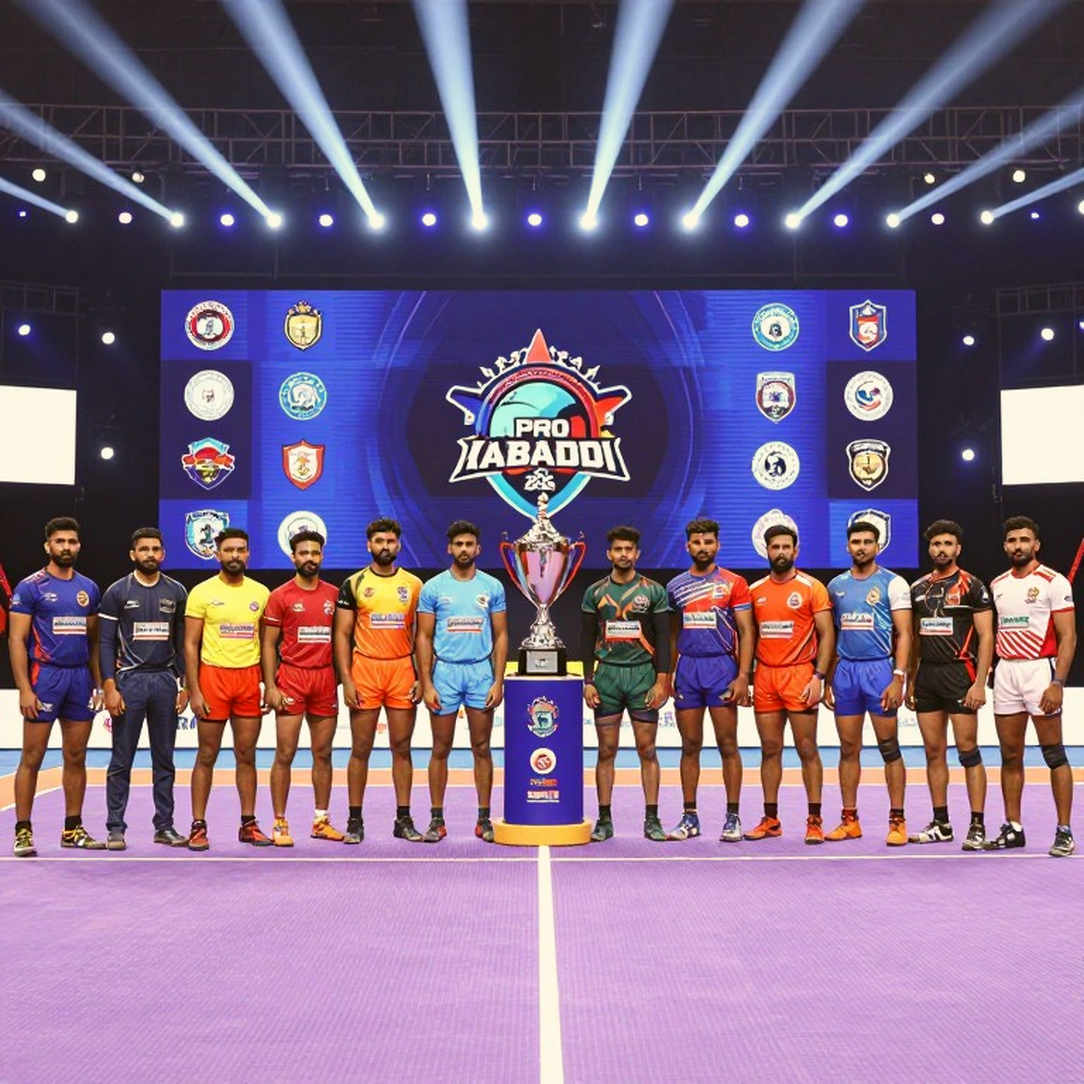
Day 1 went like this. In Group A, Sri Lanka won 48-21 (+27), India beat England 46-26 (+20), and Uganda beat Malaysia 45-29 (+16). In Group B, Scotland beat Australia 59-30 (+29) and Kenya beat Singapore 48-28 (+20). The five match totals were 76, 69, 89, 72 and 74.
For readers who have never watched kabaddi, three rules need to be fixed in place once, because everything below rests on them. First, the raider must chant “kabaddi, kabaddi” continuously through the raid — that is the cant. If he pauses for breath, the raid is void and he is out. The entire attack must be completed in one breath, and that is the sport's strangest and finest rule. Second, the bonus line sits deep in the opponent's half; crossing it earns one point, but only when the defending side has six or more players on the mat. Third, all out — when all seven of one side are dismissed, the opponent gets two extra points and the entire team returns to the court. That is why kabaddi scores swing in a single raid, and why score difference inflates and collapses so fast.
The press box had a rhythm before I ever had a byline. In 2026, at Balewadi in Pune during PKL Season 5, I was the only woman in a fourteen-person box. Puneri Paltan beat Bengaluru Bulls 34-31 and I stayed forty minutes past the final whistle because the crowd outside the gate was arguing about Deepak Hooda's 11 raid points and Girish Ernak's 4 tackle points. I wrote down 23 questions that night and asked Hooda two of them in the mixed zone. He answered the one about his third raid, not the one about the table. Since then, every match report of mine has carried at least one supporter's name. And that habit taught me never to read a table alone — read it alongside the voice sitting in the stands.
The arithmetic is sound; the structure is misleading
Back-calculate the Day-1 table and the ranking logic falls into place. Group A: Sri Lanka 48-21 (+27), India 46-26 (+20), Uganda 45-29 (+16). Group B: Scotland 59-30 (+29), Kenya 48-28 (+20). The organisers are running the standard rule and the numbers in the report are internally consistent and arithmetically verifiable. In journalism that is not a small thing. When you can add up a report's figures yourself and they hold, the factual layer earns trust.
That same rule has a second face, and the second face is the problem. Ranking by score difference means, mechanically, that teams which have not yet played sit above teams that have lost. Nigeria is fourth in Group A without a single match. Bangladesh and Canada are third and fourth in Group B without a single match. This is not a reporting error; it is an artefact of the table's construction.
The practical consequence is that Day-1 standings carry almost no predictive value — and in Group B, less than that. Bangladesh, which has not yet played, is in all likelihood the strongest side in that group, and the table is hiding it in third place. A reader who has only seen the standings will conclude Bangladesh is weaker than Scotland and Kenya. On paper it looks weaker. On the mat, probably not.
There is a second structural point that gets skipped. Group A has seven teams, Group B has six. Across a full round-robin, Group A sides play six matches and Group B sides five. Two problems follow. Unequal match counts make cross-group score-difference comparisons less fair. And in the smaller group the incentive to run up a margin is sharper, because a single blowout can decide top spot. Scotland's 59-30 demolition of Australia is that incentive made visible.
There is a flaw in the format that the numbers expose directly. When ranking runs on score difference, the rational strategy for a strong side is to maximise the margin against a weak opponent, not to manage minutes or test the bench. The result is that scorelines like 59-30 and 48-21 become normal, and the event's competitive credibility thins. Why would a spectator pay to watch a match whose result already looks decided?
The scoring environment offers one more hint. The five Day-1 matches produced totals of 76, 69, 89, 72 and 74. Scotland-Australia at 89 was the day's highest, and by ordinary kabaddi standards that points to a weak defensive structure on at least one side. Caution is required here — the report carries no tackle counts and no raid-success percentages for any match, so this is a directional read, not proof.
Lovepreet Brar's 23 raid points: a fine innings and a dangerous dependence
The report contains exactly one individual statistic: Scotland's Lovepreet Brar, 23 raid points. It is the brightest number of the day and also the one that most demands interrogation.
Look at the maths. Scotland scored 59, of which 23 came from Brar's raids. That is at least 39 per cent of the team total from one player. And 39 per cent is the floor, because a team's total also includes tackle points, bonus points and all-out points. Measured against raid points alone, his share climbs above half.
Twenty-three raid points implies at least three or four super raids — raids yielding three or more points in a single attempt. Four super raids in one match means the opposing defensive line simply could not stop him. That is an excellent performance.
And this is where the questions begin. The 23-point figure needs heavy discounting for the quality of the opposition. Australia conceded 59, the worst defensive display of Day 1. Twenty-three points in a single match against the weakest defence in the group is not evidence of a sustainable level. In PKL analytics, one match sits entirely inside the noise band; a raider's true level needs eight to ten matches, or a full season, to establish. Calling Brar a breakout star on this one innings would be premature.
Then comes the thing almost everyone writing about overseas kabaddi leaves out — the name. “Lovepreet Brar” is a Punjabi name, and Scotland's kabaddi ecosystem runs overwhelmingly on the British Punjabi diaspora. Diaspora kabaddi is culturally rooted in Circle Style: a circular field, one-on-one attack and defence, popular in rural Punjab. A player raised in that tradition must adapt to Standard Style's 7v7 positional defence, the finer points of the bonus line, and the thirty-second cant discipline.
That adaptation gap is the most under-reported story in diaspora kabaddi, and it plausibly explains the 89-point total in Scotland-Australia — loose structured defence on both sides, points flowing at both ends. In Circle Style the logic of defence is different; you fight one raider. In Standard Style you build a chain of seven and close him in, and when one link breaks the whole structure falls.
One more thing the report never states, and the risk is real. It does not say whether the tournament is being played under Standard Style or Circle Style rules, or some hybrid. Scotland, England, Canada and Australia all draw on a diaspora base where Circle Style dominates. If officiating standards are inconsistent, every technical statistic changes meaning. That is not a detail about rules; it is the foundation on which any analysis stands.
Africa's signal, and India's unreadable scoreline
Two wins on Day 1 received almost no attention. Kenya beat Singapore 48-28; Uganda beat Malaysia 45-29. Both comfortable African victories over Asian opposition.
In the standard narrative of kabaddi's internationalisation, African teams are cast as participants rather than competitors. Two African wins on the same day is a small signal, but a signal. The correct conclusion is “worth tracking,” not “power shift.” One match and zero statistics will not support more.
India, meanwhile, is second in Group A after beating England 46-26. A twenty-point margin is solid, but by India's standards it is not dominance. Sri Lanka's margin (+27) was larger. And the decisive variable is missing — squad composition. The report never says whether India fielded its senior national team or a development side. Until that is known, 46-26 supports no conclusion at all. If this was the senior team, England's 26 points are a concern. If it was a development side, 46 points is encouraging news. One scoreline, two opposite meanings.
Not a single Indian player's statistic appears anywhere in the report — no raid points, no tackle points, not even a name. That editorial choice is itself information. It tells you the report was compiled from a results feed or a standings sheet rather than from a seat at the mat. No quotes, no sources, no tactical description. When no reporter was watching, what lands in the copy is what the scoreboard printed.
“Commonwealth” is a membership label, not a measure of competition
Here is the part almost nobody writing about this event pauses on. The word “Commonwealth” in the title is not a neutral descriptor. It is a structural filter.
Kabaddi is not a Commonwealth Games sport — it has never been on the programme — and nowhere does the report mention Commonwealth Games Federation sanction or affiliation. “Commonwealth” here is a membership label, not a proof of standard.
And what the label excludes is the most important thing about it. It excludes Iran, kabaddi's undisputed second power and the only nation to have broken India's men's gold monopoly at the Asian Games. Iran is not a Commonwealth member. It also excludes South Korea, which has invested systematically in the sport for a decade.
The implication is clean: an event that does not include the second-best team in the world cannot measure kabaddi's internationalisation. It can show India's depth, it can show the progress of newer nations, but it cannot show the global balance of power.

I have been repeating that since 31 August 2026. In Jakarta that day, India's men lost the Asian Games semi-final 18-27 to Iran after a 23-24 group defeat to South Korea, and took bronze; the women lost the final 27-24 to Iran. Rituals don't glitter. They ring — and that night the ritual stopped ringing.
Outside the GBK that night I stayed with sixty Indian supporters, and in the mixed zone Fazel Atrachali told me Iran had planned for India's third-raid pattern. That sentence changed how I write. Since then every preview of mine carries a section on how India loses, and the Iran file carries Atrachali's tackle numbers. I stopped writing gold as ritual that night.
Now read the Ahmedabad table through that lens. Iran is not here. That does not mean India will win; it means India will not be properly tested. A team that is not playing Iran cannot discover its own weaknesses.
And now the question no score sheet contains
For several years I have made one paragraph mandatory in every profile — the livelihood paragraph. Before form, I ask about off-season work, family income, gym access. It began in the empty year of 2026, when PKL Season 8 was postponed. Across 87 days I tracked fourteen Puneri Paltan players. Nine had gone back to family farms in Haryana and Uttar Pradesh; only three had gym access. I ran 47 phone interviews and one 90-minute video call with defender Girish Ernak, who was doing rope-skipping on a terrace. What the hiatus asked wasn't answered then, and it isn't answered now.
There is no money anywhere in that A4 sheet. No prize purse, no match fee, no contract, no broadcast rights, no line about what the players are being paid. Kabaddi's history is fundamentally an employment story — railway clerks and police constables before 2026, crore-rupee PKL auctions after, and in between the mud-court player who got neither. When a tournament writes “championship” in its title and says nothing about what a player earns, that is my first question.
The report does not answer it, and that is the largest gap of all. Until we know what these players are being paid, we cannot judge whether this event is doing something for kabaddi or is one more calendar-filling fixture.
What is being misread from outside
The most common outside reading of this championship is that it proves kabaddi's global expansion — thirteen nations, four continents, new flags. It is an attractive reading, and it is wrong.
An event that does not include the world's second-strongest team cannot measure global expansion. Scorelines like Scotland's 59-30 and Sri Lanka's 48-21 do not show global competition; they show uneven competition. A raider taking 23 points at one end and a defence conceding 59 at the other is a picture of a gap, not of growth.
The real signals lie elsewhere, and there are two. First, Kenya's and Uganda's wins on the same day — evidence that African kabaddi is moving from participation towards competition, however slowly. Second, Bangladesh. A team that has not yet played may be the strongest side in Group B, and the table is concealing it in third place.
Sharper still: the Day-1 table is not merely provisional, it is structurally misleading. The report repeatedly notes that the table could change. That is factually true and analytically inadequate. The table will not change merely because matches remain; it misleads because three teams sit mid-table purely for not having played. That ordering is a product of the calendar, not of competitive merit.
What to watch next
Three things on Day 2. First, Bangladesh's opening match — if they beat Scotland or Kenya, the entire Day-1 table must be thrown away, along with the confidence it gave anyone. Second, India's playing seven — if senior players are resting, the meaning of 46-26 changes, and so does the purpose of the whole event. Third, and most important, whether the organisers publish raid-success percentages and tackle counts. On the day those numbers appear, Lovepreet Brar's 23 points can be read as 23 points rather than as a miracle.
The boy standing in front of that wall is still with me. Nigeria beat nobody, and Nigeria is fourth. The table is not lying to him — it is answering a question he did not ask. That is kabaddi's largest risk: you read a correct score, conclude the wrong team is strong, and then that team walks onto the mat.