
Osaka's Homecoming: The Serve Fires in Tokyo, but the 'Form' Claim Still Awaits Data
नाओमी ओसाका ने टोक्यो में टोराय पैन पैसिफिक ओपन (WTA 500) के पहले दौर में जैस्मिन पाओलिनी को 6-3, 7-6(4) से हराया — मैच एक घंटे सैंतीस मिनट चला और ओसाका ने 7 एस बनाम 1 एस की बढ़त दर्ज की। यह जीत घरेलू दर्शकों के सामने आई और मियामी की हार का बदला थी, जिससे दोनों के बीच करियर का रिकॉर्ड 1-1 हो गया। ओसाका WTA 500 में सातवीं बीज हैं; शीर्ष बीज एलेना रायबाकिना को पहले दौर में बाय मिला है, जबकि दूसरे और चौथे बीज चोट के कारण हट चुके हैं, जिससे ड्रॉ काफ़ी खुल गया है। विश्लेषण की मुख्य बात यह है कि सात-एक का एस अंतर सर्विस के दबदबे को दिखाता है, लेकिन रिपोर्ट में पहली सर्विस प्रतिशत, रिटर्न गेम्स जीतने का आँकड़ा या ब्रेक-पॉइंट डेटा नहीं है — इसलिए 'रिटर्न के बाद सबसे अच्छा टेनिस' का दावा अभी सिद्ध नहीं, बल्कि एक राय है। इसके अलावा ओसाका की उम्र 29 बताई गई है जो उनके जन्म (अक्टूबर 1997) से मेल नहीं खाती, और रायबाकिना को शीर्ष रैंकिंग बताने तथा च्वालिंस्का को दूसरा बीज बताने वाले स्रोत-दावे भी सत्यापन-योग्य नहीं हैं।
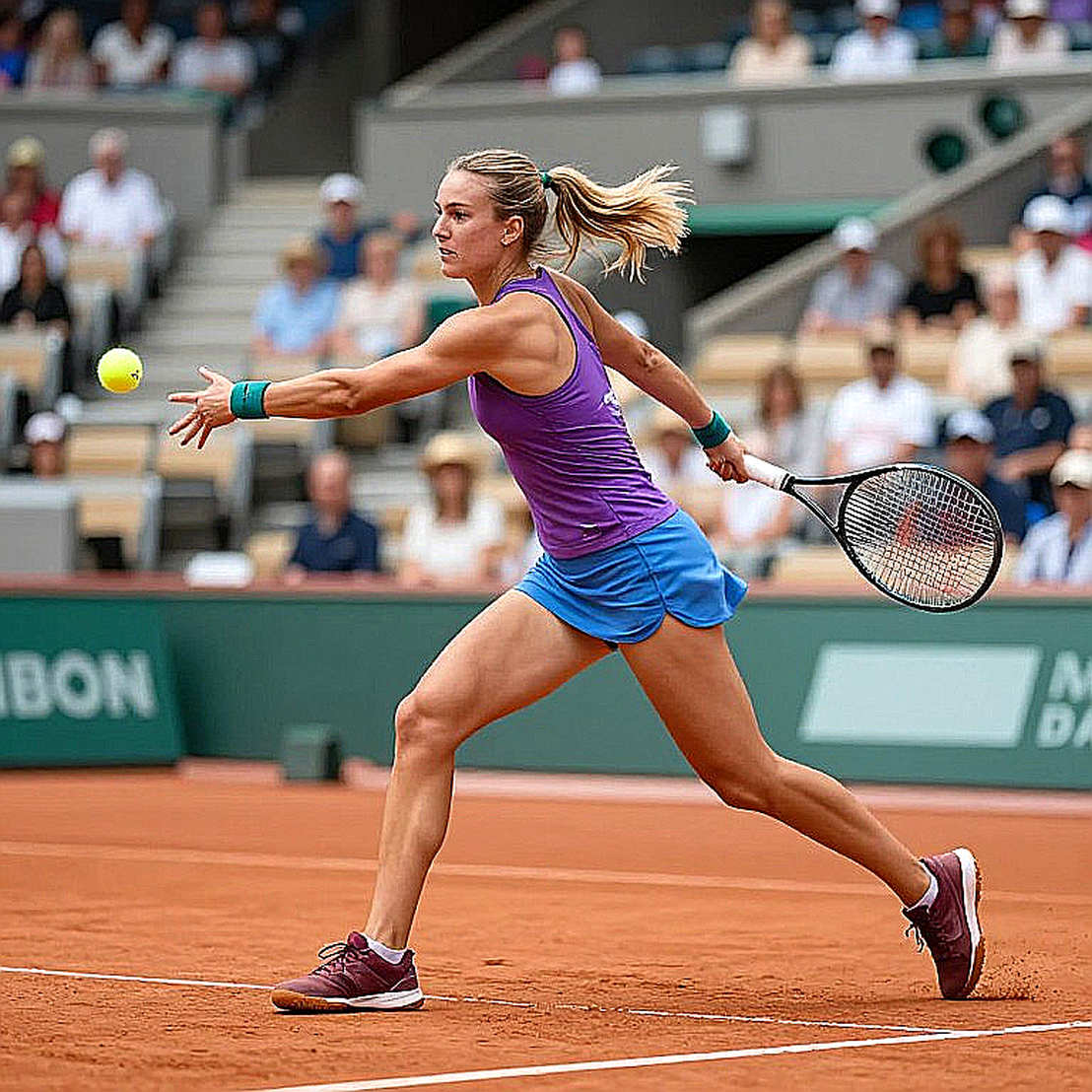
Tokyo: Playing in front of a home crowd has never been merely a tournament for Naomi Osaka — it is a national event. In the first round of the Toray Pan Pacific Open she beat Italy's Jasmine Paolini 6-3, 7-6(4) in one hour and thirty-seven minutes. The scorecard reads like a clean, controlled win: two sets, no third set, no major crisis. But the true character of the match is revealed not by the scoreline but by the service column — seven aces for Osaka, one for Paolini.
That differential is the axis of the entire story. Seven to one indicates the serve was operating as a free-point generator, and Osaka's whole game model rests on that precondition. When the serve supplies comfortable holds, her aggressive, flat, first-ball baseline attack flourishes. On the day that support wobbles, both her return game and her tolerance for long rallies are exposed. In Tokyo, the support was there.
Serve is Osaka's true identity. Paolini's profile is built on movement and return — keeping the ball alive, breaking rhythm, extending rallies to wear opponents down. Such players have historically troubled flat, high-power baseliners, especially when the first-serve percentage dips. Osaka avoided a third set, which is a positive signal. But the report contains no first-serve percentage, no second-serve points won, and no return-games-won figure. The technical conclusion must therefore be called directional, not decisive.
A duration of 1h37m is on the higher side for a straight-set win. It means the second set was genuinely contested and stretched to a tiebreak. The match was decided by serve plus clutch play rather than by baseline superiority. Winning the tiebreak 7-4 is a good sign, but it is a single-sample sign; no large claim about clutch ability can be built on it.
Avenging the Miami loss adds another thread — the career head-to-head now stands at 1-1. The natural inference is a tactical adjustment rather than a pure form swing, but the report offers no shot-level or positional detail, so the mechanism cannot be identified. That link stays open.
A basic error in modern tennis analysis is treating ace counts alone as proof of form. Aces are a high-variance output that swings sharply match to match. The stickier indicators are first-serve percentage, second-serve points won, and return-games-won percentage — and none of those are present here. The claim that she is playing 'some of her best tennis since returning' is therefore an opinion, not a finding. It was presumably offered in the context of a home win, a framing bias common in tournament-week reporting. Osaka's commercial and traffic value runs far ahead of her current competitive evidence base; conflating the two is the biggest analytical mistake available.
A note on source integrity is necessary. The report states Osaka is 29, whereas she was born in October 2026 — placing her at 27-28 in the plausible windows for a Tokyo event. It describes Elena Rybakina as the WTA's top-ranked player and Maja Chwalinska as the No. 2 seed at a WTA 500; neither claim matches established facts. Any analysis built on these figures must verify them against official records first.
Structurally, this edition of Tokyo is a soft 500, and that matters. First, the tier: WTA 500 is non-mandatory, sitting outside the compulsory 1000 and Finals commitments. Second, the calendar: it follows immediately after the US Open, a phase marked by travel load, post-Slam motivational asymmetry and elevated withdrawal rates. Third, the withdrawal of the No. 2 and No. 4 seeds through injury removed two significant obstacles from Osaka's path.
The direct implication is that a deep run here should be read as ranking-points accumulation rather than as proof of level. It is entirely valid for ranking purposes; it must be discounted for level purposes. Top seed Rybakina, with a first-round bye, is the most likely late-stage blocker, and her serve-plus-flat-power profile neutralises part of Osaka's main weapon — that would be a serve-versus-serve contest in which the return game becomes decisive. The reported No. 2 seeding for Chwalinska is highly atypical at this level and points either to an unusually thin entry list or a source error; it bears directly on how much credit the draw deserves.
Osaka's current ranking is not stated. A No. 7 seed at a WTA 500 implies roughly a 25-40 band after accounting for two confirmed withdrawals, but that is inference, not fact. If the band is right, she is under-seeded relative to her hard-court ceiling — seeded but not favoured, and therefore a live 'dangerous floater' in any hard-court draw. Her ranking is more likely constrained by selective scheduling than by raw level: the postpartum return context implies a structurally reduced event count and travel footprint, and family logistics typically constrain a mother-athlete's calendar more than injury does, producing a persistent points-accumulation deficit that no single win resolves. Points expire on a 52-week rolling cycle, so what she defended in last year's Asian swing is the most relevant question — and the report does not answer it.
All four of her Grand Slam titles came on hard courts. That is both her strength and her ceiling: clay and grass adaptation remain the structural weakness. Her competitive value is concentrated on one surface, which caps her ranking upside across a full calendar while maximising her value in the Asian hard-court swing. Her season should be evaluated in hard-court blocks, not annual totals.
The report contains zero team information — no coach, no fitness staff, no agency. Any conclusion on those fronts would be speculation, and this dimension must be recorded as data-deficient. The most managerially significant item in the set is instead a career-intent statement: Osaka saying she would step away if her daughter asked. That is a public declaration that her participation is conditional rather than unconditional, and for a player building a second peak it is both a scheduling and a team-investment risk factor. Read charitably, it is pre-emptive boundary-setting rather than a retirement announcement — but it shortens the market's assumed career horizon. Home-event media load is manageable but real: for a player with a documented sensitivity to public pressure, playing before a national audience is a higher-variance environment than a neutral draw.
The media narrative is currently 'homecoming hero / mother-athlete second act'. Its fundamental support is weak to medium: one win, one ace differential, no process metrics, a sample of one. The expected narrative duration is short-term — under a month — unless she reaches the final or beats a top-10 player. Expectations and reality diverge: the home crowd wants a deep run, perhaps a title in a weakened draw; a quarterfinal-plus is plausible, and a title depends on the Rybakina half. The implied upward ranking trajectory is optimistic given selective scheduling and surface concentration. The implicit arc of 'a champion rediscovering championship level' is not supported by facts that say only 'a former champion won a first-round match at a 500'. That gap is the exploitable insight.
From an industry perspective, Osaka is the single most consequential commercial anchor of the Asian hard-court swing. Her participation measurably changes ticket demand, broadcast value and sponsor activation for a 500-level event that would otherwise be a mid-tier property, and the effect transmits downward into participation, court bookings and junior enrolment in Japan. Simultaneously, the withdrawal cascade is a systemic signal: the value of late-season 500s increasingly depends on local stars rather than field strength, shifting commercial risk onto the host market. If Osaka's appearances become sporadic, the swing's centre of gravity shifts toward Chinese events and the next emerging local star. The tension between tier inflation and actual field quality is visible in this very draw.
In the risk matrix, the highest-severity item is not form but career conditionalism: a stated willingness to leave the sport on a family trigger can terminate a comeback at any point regardless of results. Second is serve dependency — if the first-serve percentage drops, elite returners extend rallies and neutralise her. Third is physical load and injury, with no fitness data available. Fourth is home-market overhype generating backlash if results regress. No rules, integrity or disciplinary exposure is visible in this information set. The overall rating is medium, driven less by what the report says than by what it omits.
Signals to track: first-serve percentage and second-serve points won (high aces with a sub-par first-serve percentage would indicate a high-variance serve masking rally weakness); return games won across a three-to-five match sample (below roughly 25% would confirm a hold-only profile); entry patterns for the next three events (a withdrawal or sharply trimmed schedule would be consistent with conditional commitment); results against top-20 opposition (a top-10 hard-court win would be the first genuine evidence of a level jump); withdrawal rates across late-season 500s (repeated top-four withdrawals mean field-quality inflation); and public statements on career horizon (explicit timeline language would reprice her commercial and competitive outlook).
Conclusion: this is a thin, single-match report whose real analytical value lies in three structural signals — a four-time Slam champion consolidating a hard-court-only second career; a WTA 500 whose field was hollowed out by withdrawals, inflating the value of the result; and a public statement that makes her career continuation explicitly conditional. The serve worked in Tokyo. One day's serve does not set a career's direction. Osaka's real test lies in the next three to four weeks, in the numbers this report does not contain: return games, second serve, and results against the top 20. Until those arrive, treat 'best tennis since returning' as a handsome sentence, not an established fact.
(Note: several source claims — Osaka's age of 29, Rybakina as top-ranked, Chwalinska as No. 2 seed — could not be verified and are explicitly flagged. Sports results are highly uncertain; please treat the conclusions rationally. This piece is for sports-information reference only and is not betting advice.)
संबंधित खिलाड़ी
लोकप्रिय/पसंदीदा पुस्तकें
Linda Noskova Secures WTA Finals Semifinal Place with Straight-Sets Win over Coco Gauff2026-11-11
Missing Evidence in Tennis Analysis: No Player, Tournament or Performance Data Available2026-11-10
Monfils' Farewell: When the 'Showman' Quietly Put Down the Racket, the Court Echoed His Name2026-11-04
The Ledger of Zero: The Tennis Story That Carried Not a Single Number2026-11-09
अनुशंसित
From 5-4 in Paris to the Eighth Seat in Turin: Alcaraz's Two Match Points, Shelton's 19 Aces, and the Arithmetic of the 11:30 Window2026-11-08
The Ledger of Zero: The Tennis Story That Carried Not a Single Number2026-11-09
American Politics Under a Tennis Headline: An Autopsy of a Broken Analysis Pipeline2026-11-05
The Corridor Changes Tempo in Paris: What the Scoreboard Won't Tell You About Shelton vs Paul2026-11-06
The Document of Nothing: When a Tennis Story Comes Back Empty2026-10-25
The First Question Before Any Tennis Analysis: Where Is the Source?2026-11-07
Neck Injury Halts Rybakina's Tokyo Run, Withdrawal Before Quarterfinal2026-10-31
अनुशंसित
The Document of Nothing: When a Tennis Story Comes Back Empty2026-10-25
The Empty Half of the Draw: Chennai's Twenty-One Ledgers and the Arithmetic of India's Missing Women's Tour2026-10-30
The Lesson in an Empty Template: Where the Tennis Data Pipeline Breaks2026-11-03
The Corridor Changes Tempo in Paris: What the Scoreboard Won't Tell You About Shelton vs Paul2026-11-06
Rybakina's Empty Week: Where the Body Stopped, the Calendar Sent the Invoice2026-11-09
The Ledger of Zero: The Tennis Story That Carried Not a Single Number2026-11-09
Neck Injury Halts Rybakina's Tokyo Run, Withdrawal Before Quarterfinal2026-10-31
अनुशंसित
Osaka's Homecoming: The Serve Fires in Tokyo, but the 'Form' Claim Still Awaits Data2026-10-28
ATP Rankings: Zverev Takes No. 1 Spot, Sinner Slips to Second; Jodar Breaks Into Top 102026-11-04
The Record That Arrived Empty: One Day's Ledger at the Tennis Desk2026-10-25
Missing Evidence in Tennis Analysis: No Player, Tournament or Performance Data Available2026-11-10
The Lesson in an Empty Template: Where the Tennis Data Pipeline Breaks2026-11-03
Neck Injury Halts Rybakina's Tokyo Run, Withdrawal Before Quarterfinal2026-10-31
अनुशंसित
ATP Rankings: Zverev Takes No. 1 Spot, Sinner Slips to Second; Jodar Breaks Into Top 102026-11-04
The Empty Half of the Draw: Chennai's Twenty-One Ledgers and the Arithmetic of India's Missing Women's Tour2026-10-30
Osaka's Homecoming: The Serve Fires in Tokyo, but the 'Form' Claim Still Awaits Data2026-10-28
The Lesson in an Empty Template: Where the Tennis Data Pipeline Breaks2026-11-03
American Politics Under a Tennis Headline: An Autopsy of a Broken Analysis Pipeline2026-11-05
Neck Injury Halts Rybakina's Tokyo Run, Withdrawal Before Quarterfinal2026-10-31
The Tennis Information Void: Data Extraction Failure Halts the Entire Analysis2026-11-09