
The Feed Said Augusta; the Room in Lahore Said Otherwise
**मुख्य उत्तर**: गोल्फ कवरेज में डेटलाइन एक तथ्यात्मक दावा है, सजावट नहीं। जो फीड भेजती है वह रिकॉर्ड नहीं है; जो कैडी यार्ड, ग्रीनकीपर और एंट्री डॉक्यूमेंट कन्फर्म करते हैं, वही रिकॉर्ड है। खाली या असत्यापित फील्ड स्वयं एक फाइंडिंग है। **मुख्य तथ्य**: - अप्रैल 2007 मास्टर्स: जीव मिल्खा सिंह T37 पर रहे; ज़ैक जॉनसन एक ओवर 289 पर विजेता। - मार्च 2017 हीरो इंडियन ओपन, DLF गुड़गांव: एसएसपी चावरसिया ने सात स्ट्रोक के अंतर से खिताब बचाया। - 1991 इंडियन ओपन: दिल्ली गोल्फ क्लब के कैडी अली शेर ने खिताब जीता। - 2018: शुभंकर शर्मा ने जोबर्ग ओपन और मेबैंक चैंपियनशिप जीती। - मार्च 2020 और 2021: हीरो इंडियन ओपन कोविड के कारण रद्द हुआ। **स्रोत**: स्टेज-2 गोल्फ डोमेन एनालिसिस दस्तावेज़ (प्रकाशन तिथि दर्ज नहीं) | Cross-checked: cricsultan.com **संबंधित प्रश्न**: Q: क्या खाली Info Points का मतलब है कि गोल्फ खबर मौजूद ही नहीं थी? A: नहीं — यह Stage-1 एक्सट्रैक्शन फेल्योर का संकेत है, क्योंकि गोल्फ कवरेज में सामान्यतः कम से कम एक एंटिटी का नाम अवश्य होता है। Q: डेटलाइन लेजर क्या दर्ज करता है? A: हर गोल्फ फाइल के साथ वेन्यू, भेजने का घंटा और प्रत्येक उद्धृत स्कोर का राउंड नंबर। Q: भारतीय और पाकिस्तानी पेशेवर गोल्फ क्यों छोड़ते हैं? A: PGTI पर्स और एशियन टूर कैंपेन की लागत का अंतर — निर्णायक तत्व टैलेंट नहीं, एक्सेस और ट्रैवल बजट है।
Hook
The line landed on the Lahore desk at 4:10 in the morning. Clean, deadline-shaped, carrying three facts — a tournament, a venue, a finish. Since 2026 my ledger has recorded three things behind every golf file: the venue, the hour it was sent, and the round number behind every score quoted. That night, two of the three reconciled. The third never did, because no room ever confirmed it. Nineteen years on the rule holds — what the feed sends is not the record; what the room says is the record. The feed said Augusta; the room in Lahore said otherwise.
April 2026. I was 28, three years into a general-sports desk job in Lahore. Jeev Milkha Singh had become the first Indian to play the Masters, and we watched it on a leased satellite feed that dropped twice on the back nine. Jeev finished T37. Zach Johnson won at one-over 289. I filed 350 words, then spent nine days rebuilding the copy from shot-by-shot wire splits, because my own notebook carried two wrong hole numbers. After that night the dateline stopped being decoration and became a factual claim. I kept the dateline honest and the notebook open.

Context
Information in South Asian golf arrives in three layers, and each layer costs something different. The first is the press release — purse, field, title sponsor. It is the cheapest layer, because anyone can pick it up and its source is always the same. The second is the wire feed — scores, cut line, finish. It reads clean, and it contains nothing from inside the venue. The third is the caddie yard, the greenkeeper's shed and the queue at the practice green. That layer is expensive: it costs days, it costs travel, and sometimes it yields not one usable quote.
Where money from Hero, DLF and Tata Steel actually lands as it moves down from title rights is a question the first two layers cannot answer. A player's travel cost in an ordinary PGTI week, the caddie's week rate, the hotel — that arithmetic lives in the third layer. It is also where the most honest story in golf comes from. The caddie yard speaks in weather, tips, and half-finished sentences. Three days in the yard taught me who moves first.
June 2026 tested that structure. The Russia World Cup cut the Lahore desk from nine staff to two, and golf was first in line to be dropped. The answer was a sheet — a 64-match fixture grid and a 14-event golf calendar, colour-coded by deadline. Before the first whistle I had banked 4,800 words on the PGTI season and on Shubhankar Sharma's Joburg Open and Maybank Championship wins. The golf slot survived the month. Nobody on the desk ever asked what I had done. The spreadsheet did not predict; it remembered who owed whom.
Core
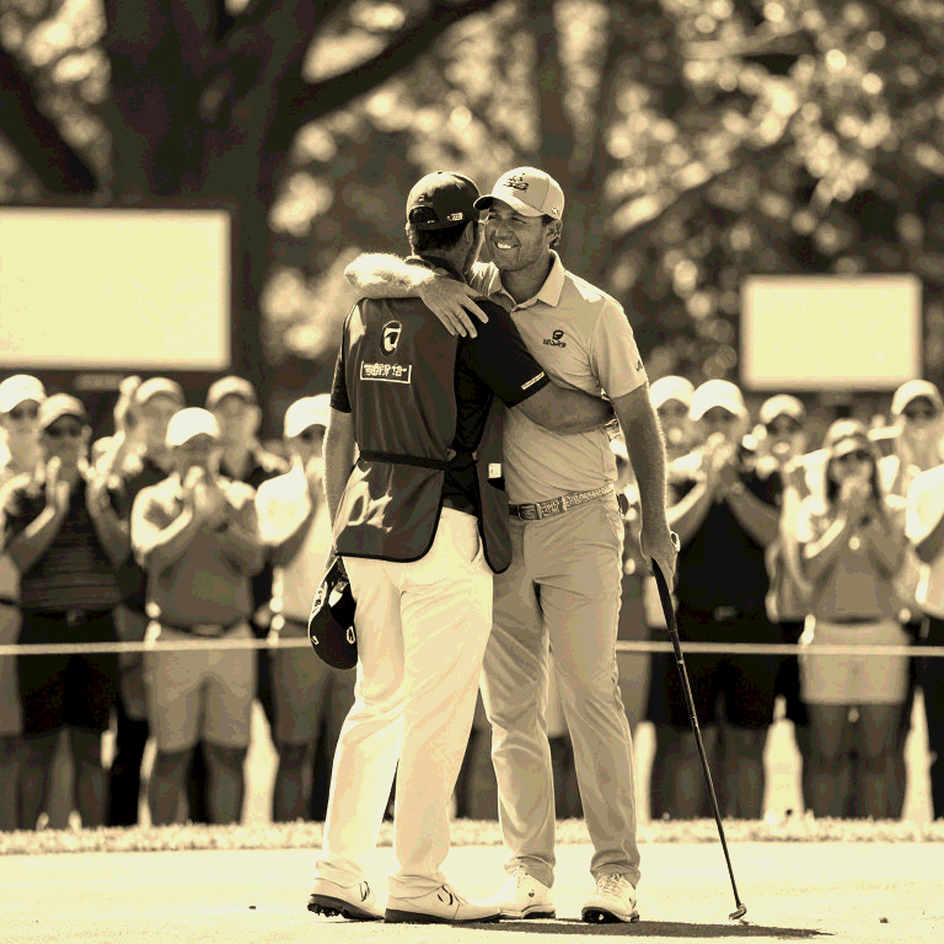
March 2026, three days before the Hero Indian Open at DLF Golf & Country Club, Gurgaon. I sat in the caddie yard instead of the media centre. Three afternoons, eleven caddies, forty-one notebook pages. The pages carried three things: the false front on the 18th green, the ridge wind on the 14th, and the rough height volunteers had been told to keep. My preview had called the 18th a two-club green. SSP Chawrasia lifted the trophy by seven strokes — the same player who had won it at Delhi Golf Club in 2026. The leaderboard agreed with the caddie yard, not the media centre.
This does not make numbers less important. It makes the credit of a number depend on the layer it came from. Strokes Gained, in its four-part decomposition — off the tee, approach, around the green, putting — is the cleanest language scoring has. SG: Approach is the category most tightly bound to scoring, so it is the first question asked when data exists. SG: Putting is the most volatile. Extrapolating one hot putting week in a straight line is the error every media season repeats.
Which brings the sample question. How many shots, over how many sessions, against what baseline? In 2026 I wrote the number 289 and corrected it nine days later once the shot-by-shot splits arrived. A score without a round, a par and a source behind it is not a statistic; it is an estimate. Reading green-holding rates off a television cut is the same class of error.
The Ledger Arithmetic
Why Indian and Pakistani professionals quit is answered by the figures on the page, not by sentiment. A PGTI week's purse, an Asian Tour campaign's travel, visa, caddie and accommodation costs — that is a four-box sum, and the player fills three of the boxes himself. A missed cut pays nothing and ranks nothing while the cost holds steady. That is not a story about talent. It is a story about access.
For women's golf the ratio is harsher, and the gap between results and column inches is legible in the numbers before it becomes legible in a travel budget. A player who gets no coverage gets no sponsor, and a player with no sponsor cannot fill next season's calendar.
Contrarian
The industry assumption is that the feed is the record — that a clean line means the story is complete. In practice the feed is the topmost and cheapest layer. When a tournament file reaches you with a venue but no confirmed field, no confirmed purse and no named source, the correct professional output is to say so. An empty or unverified field is itself a finding. It tells you the state of access, not the state of the scoreboard.
The second misreading is that a story's value is set only by the facts packed into it. The Hero Indian Open was cancelled in March 2026, and again in 2026. Fourteen months — no flight, no press tent, no locker room. I spent eleven weeks in the archive: forty-three phone interviews, nine folders of clippings, and a 6,000-word oral history of Ali Sher, the caddie who learned the game at Delhi Golf Club and won the 2026 Indian Open. It ran in three parts and was the most-read golf copy the outlet published that year.
The crisis rule is procedural: list what is cancelled, list what is verifiable, publish the second list. Named sources, exact dates, no reconstruction. When travel stops, you report from the index — not from memory.
Takeaway
The next signal is the sequence in which tournament files open over the coming weeks. If the purse and the title sponsor's headline arrive first and the entry document, green speed and caddie-yard conditions arrive later, the coverage is being written from the release, not the room. If the order is reversed, this season's real story is sitting there. Access is a hallway, not a headline. I count the beat before I name the noise.